JFK Environmental Services LLC
JFK Environmental Services LLC
Upton, MA 01568
ph: 508-344-2831
jfknott
News
Members of the Infrastructure and Climate Network (ICNet) and the University of New Hampshire Center for Infrastructure Resilience to Climate presented at the 97th and 98th Annual Transportation Research Board (TRB) Annual Meetings in Washington, D.C. in January 2018 and 2019.

Dr. Knott presenting her research on the effects of sea-level rise on groundwater with consequences for coastal road infrastructure.
- Adaptation Planning to Mitigate Coastal Road Pavement Damage from Groundwater Rise Caused by Sea-Level RiseJayne F. Knott, Jo Sias Daniel, Jennifer M. Jacobs, Paul Kirshen
January, 2018
ABSTRACT
Sea level in coastal New England is projected to rise 3.9 to 6.6 ft (1.2 to 2.0 m) by the year 2100. Many climate-change vulnerability and adaptation studies have investigated surface-water flooding from sea-level rise (SLR) on coastal road infrastructure, but few have focused on rising groundwater. Groundwater modeling in New Hampshire’s (NH) Seacoast region has shown that SLR-induced groundwater rise will occur three to four times farther inland than surface-water flooding, potentially impacting 23% of the region’s roads. Pavement service life has been shown to decrease when the unbound layers become saturated. In areas where groundwater is projected to rise with SLR, pavements with groundwater 5.0 ft (0.15 m) deep or less are at risk for pre-mature failure as groundwater moves into the pavement’s underlying unbound layers.
In this study, groundwater hydrology and multi-layer elastic pavement analysis are used to identify two case-study sites in coastal NH that are predicted to experience pavement service-life reduction caused by SLR-induced groundwater rise. Various pavement structures are evaluated to determine adaptation feasibility and costs to maintain the designed service life in the face of rising groundwater. This investigation shows that relatively simple pavement structural modifications to the base and asphalt concrete (AC) layers of a regional corridor can eliminate the 80% to 90% service-life reduction projected with 1.0 ft SLR (year 2030) and will delay pavement inundation by 20 years. Pavements with adequate base-layer materials and thickness require only AC-thickness modification to avoid premature pavement failure from SLR-induced groundwater rise.
Keywords: Pavements, Sea-level rise, Groundwater, Climate change, Coastal-road infrastructure, Adaptation planning
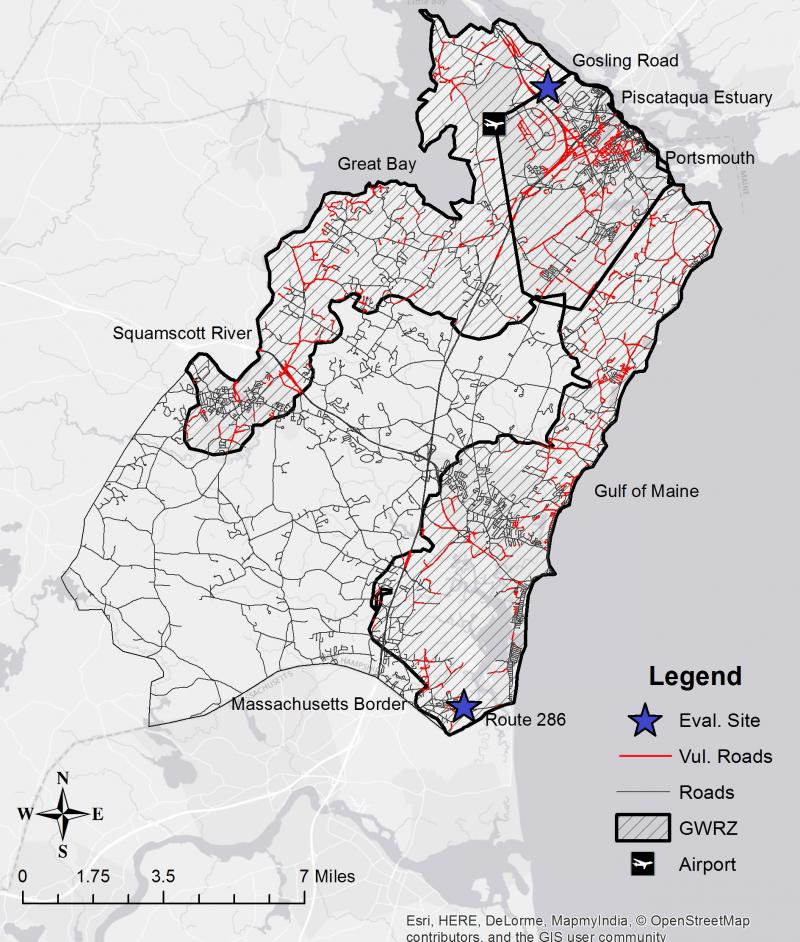
Roads in coastal NH that are vulnerable to premature pavement failure from SLR-induced groundwater rise are highlighted in red. This study was conducted at the University of New Hampshire with funding from NH Sea Grant.
Assessing the Effects of Rising Groundwater from Sea-Level Rise on the Service Life of Pavements in Coastal Road Infrastructure
Jayne F. Knott, Jo Sias Daniel, Jennifer M. Jacobs, Paul Kirshen
January 11, 2017
Abstract
Coastal communities with road infrastructure close to the shoreline are vulnerable from the effects of sea-level rise caused by climate change. Sea level in coastal New England is projected to rise 3.9 to 6.6 feet (1.2 to 2.0 meters) by the year 2100. Climate change vulnerability and adaptation studies have primarily focused on surface-water flooding from sea-level rise; however, little attention has been given to the effects of climate change on groundwater. Groundwater is expected to rise with sea-level rise and will intersect the unbound layers of coastal-road infrastructure reducing the service life of pavement. Vulnerability studies are an essential part of adaptation planning and pavement engineers are looking for methods to identify roads that may experience premature failures in the future.
In this study, a regional groundwater-flow model of coastal New Hampshire is used to identify road infrastructure where rising groundwater will move into the unbound materials during the design life of the pavement. Typical pavement profiles in several functional classifications of roadway were analyzed using multi-layer elastic theory to determine the magnitude of fatigue and rutting-life reduction expected from four sea-level rise scenarios. All of the evaluation sites experienced service-life reduction, the magnitude and timing of which depends on the current depth to groundwater, the pavement structure, and the subgrade. The use of this methodology will enable pavement engineers to effectively target coastal road adaptation projects resulting in significant cost savings when compared with the implementation of broad adaptation projects or the costs of no action.
Keywords: Pavements, Sea-level rise, Groundwater, Climate change, Coastal-road infrastructure, Adaptation planning
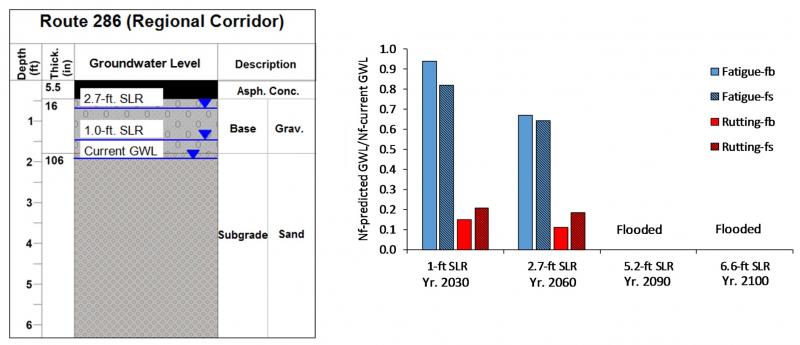
Pavement life reduction caused by SLR-induced groundwater rise at a regional connector in coastal New Hampshire - Study was conducted at the University of New Hampshire with funding by NH Sea Grant
JFK Environmental Services LLC
Upton, MA 01568
ph: 508-344-2831
jfknott